Wednesday, December 6, 2006

The TinkerX UnGrinch 25

I was involved in retail marketing for ten years, but it seems like more. Retail gives you various blech around holiday time, and that increases the time-dilation-memory factor. And while I know lots of non-marketing/sales people who are bone-weary of the over-commercialization of this time of year, I promise that if you feel that way, you got nothing on folks who've lived the dream from the inside of the tinsel machine.

If you're one of the people, like me, that thinks, "Geez. Can't we at least wait until after Thanksgiving before thinking about Christmas?" Well, in marketing, you start thinking about Christmas around September 15. And if you hate watching all the stoopid ads, well... try planning them.

I say this as a way of introducing part of my self-imposed anti-humbug plan. In order to cure myself of an ever-increasing volume of Grinchy holiday sentiments, begun during my time in retail, I'd like to share with you a bunch of the least Grinchy things I've experienced or come up with about the holidays over the years. These all relate to creativity, craftiness and the general ethos of this blog. They are non-denominational for the most part. Though, as one of my favorite lines from "Northern Exposure" went, "Dave's an animist, and he has a Christmas tree."

I do not guarantee that any of these are original to me. I'm sure other, fine creative people have had these ideas, too. If you know any of them, show link love in the comments.

1. Make a family calendar. I used to do this every year. Our theme was the "Color-it-Yourself Halendar." Hal being a stuffed orangutan I bought for my wife back when we were very young. Each month featured an outline drawing of Hal doing something... odd... and then the days were filled in with all the important family dates; birthdays, anniversaries, etc. Some years, I'd also include a weird or interesting event for every day of the year from Chase's Annual Events, or some other funky calendar. You can make monthly calendars using MS Publisher, or, with a bit more work, do one in anything that can create a table, including the ever-free and wonderful Open Office. Good to have, good to give.

2. Create your own ornaments. Yeah, it's not the most out-of-the-box idea, but so few people I know still do it. My favorite, as a kid, was to take a styrofoam shape (bell, star, even a simple ball), and stick a bajillion sequins to it with pins. Pretty. Shiny. And it keeps kids busy for hours while you do other holiday nonsense. And if just making ornaments isn't creative enough for you, force yourself to make ornaments that are alliterative; you know, where everything on your tree starts with the letter "B." That'll get you thinking.

3. Rewrite "The Twelve Days of Christmas." Let's face it, hollering, "Fiiiiive gooolden riiings!" is way fun. Way, way fun. You can not resist, so don't hold back. But what's even more fun, is hollering your own family version that only you and the clan know. Because, really... doesn't singing about how your true love gave to you... "eight maids a milking" make you a bit... uncomfortable? I mean... dude gives people for Christmas? That ain't right. Bob and Doug McKenzie not withstanding, your own version will be more fun. My son, just this morning, was singing, "Fiiiiive gooolden delicious!" Hilarious.

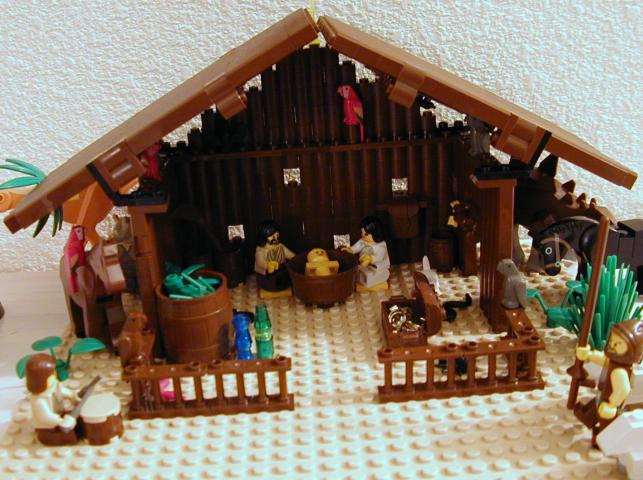
4. Lego nativity scene. 'Nuff said.

5. Indoor snow-ball fights. We spent two years of my childhood in California, after having lived in Boston, and with parents who grew up in New York. Snow ball fights are a required element of winter joy. Indoor? Substitute  aluminum foil balls, rolled-up socks, styrofoam (messy), newspaper wads, etc. instead of snow. The point is to throw things. Banzai!

6. Mall caroling. It's hard to find places to carol. Outside can get very cold. And, with kids in tow... well, it's tough. Check with a couple local malls and arrange for a time to invite anyone who'd like to participate to meet, get song books, and walk around the mall singing. See if you can arrange for an accordion player. Seriously. It adds to the cheer. If you want to charge a couple bucks to participate and also collect donations from listeners and then give the money to a local toys-for-tots charity, that makes the whole deal more righteous, and more palatable to certain civic types.

7. Toys from tots. Speaking of toys-for-tots... There are many fine organizations that gather up toys for kids who don't have them. And that's fantastic. But kids also love to make and give stuff around the holiday season, and may not have the resources. Organize an effort to provide a crafty sort of event where all the necessary parts and instructions for making a neat holiday gift are available to a group of kids who otherwise wouldn't have access.

8. Grown-up PJ party. Notice I did not say "adult." This is not a chance to play spin-the-bottle. This is about getting back to childishness. Come in PJs, bathrobes, bunny-slippers, blankets, etc. Bring your favorite (hopefully holiday related) bed-time story to read aloud to the group. Drink cocoa w/ tiny marshmallows (yes, and some brandy or JD) and have candy canes and graham crackers for snacks. Sit on the floor around the fireplace. Watch all the old
Rankin-Bass claymation holiday specials on VHS. Sing a few carols. Play...

9. Insane White Elephant. Last year, John Moore from Brand Autopsy set up an excellent White Elephant Blog. It ain't up this year. Oh, well. The basic principles of a White Elephant gift exchange apply, but anyone who has their gift taken can keep stealing from anyone who hasn't yet had their gift stolen that turn. The more people playing, the more fun. No "deceased" gifts in this version, either. Until you've had a gift stolen on any given turn, it's in play.

10. Make a truly edible gingerbread house. Every blessed gingerbread house I've ever been exposed to has been hands (and more importantly, teeth) off. Either too nice or too nasty to eat. Feh. Where's the fun? C'mon! I don't care if you stick six graham crackers together with peanut butter and put one gum-drop on top for a chimney. Figure out some way to do it, and then let the kids get all Godzilla on it. I suggest filming the fun, too.

FIIIVE HOME-MADE CAAAARD (ideas)!!!


11. Make your own envelopes. A dear friend of mine (Hi, Susan!) once sent me letters every few months in hand-made envelopes. Hers were made from interesting magazine ads. How cool is that? If you want to get fancy, do a search on the Internet for "make envelopes" and such. But the easiest way is to get the envelopes that go with whatever cards you're mailing, carefully bust 'em apart, trace them on funky paper (magazine pictures, wallpaper, wrapping paper...) and then cut, fold and glue (or double-sticky clear tape) them together. People may expect hand-made cards. Nobody expects the Spanish Inquisition. Or hand-made envelopes. Festivisimus!

12. Photoshop your kid(s) into classic pics. I first saw this done to the Raphael's "The Sistine Madonna, Detail of the Angles" painting (as shown). Although a much better job than the one I've done here, which is of my niece and nephew (Hi, Nate! Hi, Sophie!) Click on it to see a much larger image. The point is to have fun and take a picture folks will recognize and include people they will recognize. It doesn't have to be a serious pic, either. I would think that your kid climbing the Empire State Building to put a star on top would be hysterical. Use this instead of a regular picture-of-your-kids card because... well... because it's goofy.

13. Gift cards for chores, favors, hugs, etc. These were a big item when I was growing up. Don't know if other people did them. The idea was to make gift-certificates or gift cards that "entitled the bearer to (1) one doing of the dishes upon presentation of this card." You can make these intimate for your honey (I won't get into those variations here, thank you), or appropriate for work. For example, I once gave my boss ten "Andy will now pipe down" certificates. Upon presentation, I was obligated to shut my pie hole. She only ever handed me two. I believe she traded the rest in for some magic beans. Or they may be floating around on eBay... Hmmm....

14. "Puzzle Party" cards. Take, buy or make a nice picture and turn it into a jigsaw, either yourself or at Kinkos. Mail one piece to each person you're inviting to the party. When they come, they add their piece. Depending on how corn-ball you are, you can hold forth on how we're all a part of the holiday panorama of joy, etc. etc. It also serves to increase the guilt factor that motivates people to come to your party, since if they don't... their piece will be missing. Ha!

15. "Family News" cards from the future. I love this one. Lots of families I know write a very nice update about what's been going on over the last year. It's nice to hear, but... mostly it ends up being, "Dad's still working and maybe going a bit more stir crazy. Same for mom. The kids are in school and are a year older." Yawn... I like the idea of fast-forwarding a bit and writing your "Holiday Family News from 2025." Keep it just as straight-faced and boring, but mention which dimension Mary got lost in on the way to work this time. Talk about how the Martian embassy lost your passport on your 2nd honeymoon cruise, etc. etc. Much more fun. Cloning humor goes over big in this one, too.

16. Surrogate shopping party. So many of us have someone or several someones on our lists that are impossible to shop for or that we just have a mental block on. Fine. Get together for dinner and share an equal number of those folks with each other, along with a few details and a dollar ceiling per gift. Then release yourselves into a mall with a time limit. Then get back together and share the swag. I guar-ohn-tee that your friends will find stuff for your hard-to-getters that you'd never have thought of. If it ain't right? Well, 'tis the season to return stuff.

17. Decorate others' stuff. Carefully. Tastefully. Always within the bounds of office rules/etiquette and the law. But how nice would it be to enter your office (cube...) and find a wee, unexpected holiday trinket? Totally anonymous. Or to come home and have a strange, lovely wreath hanging on your lamp-post? Put a small, stuffed penguin with a Santa hat on someone's dashboard today.

18. Start a bizarre, personal holiday tradition. I heard somewhere (can't find it online, sorry... it may be apocryphal) that Amy Grant's family explodes their Christmas tree after New Year's Day with fireworks. I'm neither hot nor cold on Ms. Grant, but... that's flippin' awesome!!! So many of our holiday traditions are either copped from cultures that really aren't our own anymore, or have been entirely kidnapped by the media/mercantile world. Why not invent a new ritual that's just for you and your family? Stuff a sock with toys by the fireplace? Why? I sure as heck don't know. How about, instead, everybody in your family writes one line of a nativity poem. Or fight some gingerbread man wars. Or make advent candles from last year's used crayons. At my house, we've now been playing street hockey the day after Christmas for several years with all the in-laws. Why? Bob wanted to one year. After three years... It's a tradition!

19. Overtip, ridiculously, at least once. Food service is tough work. And around the holidays, it's even worse. People are out-and-about, running like mad, full o' holiday spirit, and, often, not very nice to the wait staff. And because we're spending more than we should on various baubles, bangles and beads... we're often a bit penurious when it comes to the everyday stuff. Which hurts the folks whose livelihood depends on our largess. So. At least once, between Thanksgiving and New Year, when you get good service and a nice smile with your meal... leave a $20 tip on a $13 lunch meal. Or, what the heck... leave $50 to cover a $22 dinner. Or $100 for a cup o' joe. Seriously. Don't make a big deal out of it. Do it, as the scriptures say, "In the dark." But do it. You'll make somebody's whole season.

20. Tell your faith's holiday story with sock puppets. You never real own a story until you tell it. I know this, because I played King Nebuchannezzar in a 4th grade production of, "Cool in the Furnace." I now own that story. Be that as it may... You can hear the Christmas, Hanukkah, Kwanzaa, Yule, Solstice, etc. stories again and again. But until you write out a script, make your own sock puppets for the players, fashion a stage from a major appliance crate and put on a show for the grown-ups... do you really grok the holiday's true meaning? I think not.

21. Do something to commemorate the Jólasveinar Boys.  An Icelandic holiday tradition involving gremlins that steal and eat naughty children...  Wee snarkies with names like "Crevice Imp," "Pot Licker," "Sausage Snatcher," "Doorway Sniffer" and "Butter Greedy." Imps that, in later, more mellow years, would come to leave potatoes for bad children rather than eating them. The children, that is. I mean, the kids could eat the potatoes, I suppose. But the Jólasveinar used to eat the bad kids. You get the picture. Do a lil' sumfin sumfin for the Jólasveinar this year. Eat a child. Leave a potato.  Your call.

22. Start a yearly journal. Very few people keep a journal. I'm a professional writer, and I don't. I'm supposed to, but I write at work, and I blog, and I write poetry and fiction and, and, and... So I've never had a daily journal. But what I do have is a notebook that I take out about once a year. Often around the holidays. And, in my case, I write in it the names of people -- everyone I can remember -- that I've met during the last year or so. And, of course, I go back and read the earlier entries and reflect on how lucky I've been to have known so many wonderful people. The names are my "touchstones" to the past. The names are bookmarks in my memory, because people anchor the most important events in my life, I think. Anyway... that's what's in my "annual journal" for the most part. Yours, of course, can be anything you want.

23. Share a resolution. We don't keep our New Year's resolutions, for the most part, because we are not really accountable to ourselves. We cheat and look the other way. So share a resolution with a friend or family member; let them hold you accountable, and vice versa.

24. Share a resolution. No, this is not a repeat. In this case, I mean make a resolution that includes another person. For example, resolve to have a game-night once a week with your family, or to go for a walk 3 days a week with your spouse. Resolve to send an email back-and-forth at least twice a month with a friend you don't see much anymore. Resolve to cook healthy for me, and I'll cook healthy for you twice a week. Resolve to help your boss with his annoying habit of not taking minutes/notes at meetings, and he can help you with your attempts at better process management. So many things that we want to accomplish are impossible alone. Resolve to be better together.

25. Thought gifts. They say (well, they say, "They Say") "It's the thought that counts." OK. So, this year, only give thoughts for the holidays. Make this they year that you and yours agree to take whatever your budget for gifts was and either give it to a charity or stick it in a savings vehicle; your call, I'm not preaching here. But for yourselves... take the time to actually say the things you haven't said. Give "the thought" behind the gift. If you're a spiritual person, pray or meditate on the subject for a bit. Do it in a card if you like, or via email. Don't make the logistics as much of a pain as shopping/wrapping/etc. That's not the point. But all the major religions that are celebrating this time of year have gift-giving as a central notion not as a potlatch per se, but as a metaphor for love, friendship, community, etc.

26. BONUS IDEA. I can't end on a serious note. It's not in my nature. So the bonus idea is a straight-up pimp for the Jumbo Mystery Box from Archie McPhee. I get one of these every year (although this year I have been strongly advised that the ladies want something non-McPhee in their stockings... geez), and use the contents for stockings, Secret Santa, random giftings, prizes for students, etc. You never know, around holiday time, when a bunch of Hindu god finger puppets, glowing eyeballs or rampaging Hun toy soldiers will come in handy.

* * * * *

Have some happy holidays this year, eh? I hope this list has been fun to read, and maybe sparks an idea or two for how to be a bit less Grinchy and a bit more Jólasveinarish.


Sunday, December 3, 2006

PlayByWiki update: now available in Thai

A few months ago, as you may remember, I converted PlayByWiki over from the paid (but lovely) wiki-farm, EditMe, to my web host's server and the Tikiwiki engine. That way I could do the dang thing pretty much free, and not worry about it.

Since then, I have done almost nothing to promote it. I mentioned it here, put up a couple mentions on a couple RPG bulletin boards, that's about it. I'm glad to say that all that hard work has paid off

;-)

We now have six games going on the wiki. And here's the thing that really tickles; three of them ain't in English. "Island PBW" is being played in French; "Island of Quakes" is in Portugese (I guess islands are popular these days...); and the "Romance of Kouvoyore" is in Thai. Yep... Thai.

I didn't think, when I started PlayByWiki, about non-English text-based RPG games. Don't know why I didn't. But I didn't. It's a "World Wide" Web, after all. Serves me right for not paying attention...

The other update is that I've posted the entire "TaleWeaver as Lightweight RPG" chapter from TaleWeaver (2nd Edition) to PlayByWiki as another game system that folks could use for text-based adventuring. The idea for tweaking TaleWeaver into an RPG came from a comment/suggestion from this blog. So... hooray for transparency and open... er... stuff. And things. Etc.

My hope is that the TaleWeaver RPG is really lightweight enough to be fun in a text/wiki/web setting. Playing something as rules-heavy as GURPS or D&D in a non-live setting can get to be onerous.

Friday, December 1, 2006

Feedback and beauty

Over at Raph Koster's Website, he's got a post up about "The algorithm or art." Using feedback to determine the "worthiness," whether economic or artistic, of songs, movies and games.

Back when I was at Cornell and actively involved in the student poetry writing scene there, we had weekly open-mic and other similar events, gang editing fests, various clubs, readings, etc. Many were quite participative. At one of these, we did an exercise once called the "Crowd Pleaser." Before the evening's main readings, we asked the members of the audience to propose and vote on a topics for new poems that would be written that night, for their immediate enjoyment.

Several topics were shouted out, and then voted upon. After that, we asked everyone to write on scraps of paper all the words that they associated with that topic. Those words were written on a chalkboard with numbers after them indicating how many people had chosen them. There were about thirty words, some of which had received as many as 7 or 8 mentions.

During the course of the night, four of us wrote poems on the topic at hand. If I remember correctly -- I don't have the piece anymore -- the subject was "daydreaming". We tried to incorporate as many of the words suggested by the crowd as possible. The poems were read at the conclusion of the evening.

The four pieces were all quite different, but the audience responded very well to each. We invited comment and sat around and talked about the experience with some of them afterward, and they said that it had felt quite interesting (one girl I knew said "tingly") to listen to poem that had been created expressly "for them," and had incorporated words provided by them. Some of the words hadn't been really easy, obvious ones, either. So it made it even more... tingly, I suppose... to hear them reflected back from the poet.

Is art better when it reflects something of what the audience already knows? Or knows it wants? We weren't making any money, so there was no "conflict of interest" between dirty commerce (that's sarcasm, children... I'm in marketing, remember) and pure art.

It was fun for me, as a poet, to write something that incorporated bits of the audience's brain. It was different. And I was certainly also using my own mind, my creative jelly, my poetic spirit in the process. There was no copping out. No crutch. No pablum. And the other three writers came up with very different results, even though the topic was the same and some of the ingredients.

This is not one of those posts where I have a nice, compact idea at the end or a suggestion. This is one of those posts where I just say some stuff and make an observation or two that kind of connects some weird points and then leaves you hanging to make your own conclusions.

Thursday, November 30, 2006

The box of purpose

My son, Dan, a first-grader, was given a writing assignment earlier this week. The directions said, at the top of the sheet, "The sky is full of dark clouds. It is very windy. A light flashes across the sky. Make a prediction of what is going to happen."

He wrote, "A aeleein (alien) will come down and sae, 'We can't sleep on Mars.' And it is nite. There is a lot of litening and rane."

He got a smiley-face and an S+ (which I guess is good). From me he got a, "That's amazing!" He explained further to me that what he meant was that all the probes and robots and landers and stuff we'd sent up to Mars were making the light (the one mentioned in the directions), and that was what was keeping the alien/Martian awake.

He put in the rain and lightning because he was pretty sure that that was what was happening, too. On the back of the sheet he drew a UFO-style space-ship with a little alien coming out of it... wearing a stocking-cap.

Totally cracked me up. Be creative, but cover yer ass.

This blog is sometimes about being more creative. I'm lucky in that I get to do that kinda stuff as part of my job. I'm even luckier that I get to do it as a Dad. In this case, because it reminded me of an important rule about creativity -- look both ways... up and down the ladder of purpose.

Usually, when we are being creative, we start with a goal; a purpose. We want to write a story or a poem or a headline or a novel. We want to design a process or invent a better mouse-trap. We want to paint a picture, improve the city's light-rail system or craft puppets. Whatever the creative task, we almost always begin with a purpose-driven ideal. A statement in our heads of, "This is what I want to achieve."

Which is fine. Except that it's not. Because, when you are finished with almost any major creative undertaking and look backwards -- down the ladder -- what you will find is that you have accomplished many different, diverging and (hopefully) wonderful things. And so, if you only have one of them in mind at the beginning, you automatically cut yourself off from creative possibilities related to those other end states. You may also avoid equally beneficial end states. Which is (duh) sad.

Take Dan's assignment. The "real" purpose is to practice writing (and, in this case, specifically, "end marks," which we used to call "periods"). But Dan's still too young to just fill-in-the-blank without having some fun with it. And that's what amused and delighted me. Of course the light in the sky is all the crap we've put on Mars, and of course it's annoying the aliens. So they come down to complain. Beautiful...

What is the secondary purpose of this assignment that Dan discovered? To be a springboard for a story. Now, the authors of the assignment probably felt that they were giving kids a fairly straightforward prompt. It's a storm, eh? Well... What if they'd been a bit less direct? I mean, Dan is *my* kid, after all. I train him to be a bit more berzleplazzgick than the norm, so while I'm thrilled he found the aliens in his homework, I'm not surprised. With a bit more planning (and a bit less rigidity), though, this assignment could have been a story-seed for a much greater percentage of Dan's classmates.

I run into this all the time at work with projects that have both a product goal (something that needs to get done) and a repeatable process requirement (the way that we do things). Can we improve the process? If you don't assume the answer is, "Yes," you leave money on the table. So the purpose of any given project is to both "do the thing" and to find out how to do it better, eh?

Examples. We need examples. I hate windy blog posts without examples and I write too many of them myself. Here we go:

  • When you write something at work, Purpose(1) is often to make a particular point to a particular audience. Can that audience be multiplied? Can you invite someone else to join you in the writing process? Can you radially change the writing to fit another medium?

  • If you are drawing or painting or otherwise being artistically creative, Purpose(1) is to create the object. The explicit Purpose(2) is often to improve that craft skill. Can you involve prayer or meditation in that activity or time? Can you invite a friend or child to join you, making it a shared, social event? Can you film yourself doing your thing so you can watch it later and learn from that experience? Can you create on a radically new medium that you were planning on throwing out (pizza box, old CD ROMs, rags, coffee filters) in order to experience the simple thrill of new textures?

  • If you are writing creatively (let's say a poem), can you force yourself to include details that require study and new learning?

  • If you are doing a hobby craft (scrap-booking, sewing for fun, jewelry design, etc.), can you think of ways to make multiples of the same thing more quickly in order to monetize your product? Can you invite someone else to learn from you or to learn from? Can you explore literature or movies that include your craft before or during the process? Or other cultures? Can you incorporate hidden ("DaVinci Code?") meanings into your work?


My point is just this... Before beginning any creative venture, write down what it is you are trying to accomplish. Your first purpose. That's important. Because you clearly want to get that done. But don't let that goal be a restrictive box. Let your creativity be bigger than that.

Ask yourself, "When I have walked the road to this goal, what else will I have seen?" And then, before you begin, widen the road.

Sunday, November 26, 2006

Powerpoint is not evil. You are. Yes, you.

A wonderful coworker of mine (if she gives me permission, I'll edit this and name her) pointed me to a good blog post about Edward Tufte, the evils of Powerpoint, information design, the ability of well-designed misinformation to intentionally mislead, and of badly designed information to unintentionally mislead. That post in turn links to another one that talks about how Powerpoint is now being taught in schools.

As usual, the angle is that the "cognitive style of Powerpoint" -- bullet points, illustrations, short headlines, outlined organizational style presentations -- is sapping our kids' attention spans and their ability to put together long, complex essays and thought pieces.

I like much of what Tufte has to say in the same way that I like much of what Freud has to say. It is interesting at the level of "I hadn't thought of things in that manner," but I think their exact prescriptions need to be taken with food and not before operating heavy machinery. Good stuff at a macro level, but not necessarily useful when building a garage.

Do I think that Powerpoint can lead to lazy thinking? Yes. But so can typewriters that don't let you erase easily.

The greatest single gift God ever gave my writing was the "Backspace" key. In the two years at college I had before I owned my own PC, when my writing tool was an electric typewriter that required weird-o correcting tape that sometimes (read: almost never) worked, my efforts at editing were limited to what I bloody-well-felt-like based on my time available, energy level and sobriety. I did a first draft by hand, on yellow legal pads, and then did as good a job as possible on the typewriter. If I had a brilliant idea on how to change the first paragraph, but was 2/3 of the way down the piece... 9 times out of 10 my response was, "Screw it."

So. Powerpoint. Children. Thinking. The medium is the message. Right...

When I was in college, I typed around 60 words-per-minute. That was after having taken one 10 week high-school typing course. Now, 20-odd years later, I type around 105 wpm. And the college kids I know beat me most days. My point? Easy backspace don't mean bad typing. It means more typing. Which means faster typing. Which means more writing, more editing, more thinking, more chances to say, "Hmmm... I think that paragraph would go better... there... and I think I'll move stuff around so that the conclusion is actually the intro, and we'll add two more examples..." etc. etc. You get the point.

Now... Does the backspace key guarantee that I'll do that? Of course not. But it makes it more bloody likely than it did when I had to use weird-o correcting tape.

With Powerpoint, you are given a number of templates. Nice. We love templates! Or, let me be clear. YOU love templates. I hate them. Because they are often so off-brand for what I have to do in my day job that my crew needs to spend many hours un-templatizing all kinds of crap in Powerpoint, Word, etc. so that it looks like what we (Marketing Gods) need it to look like rather than what Mr. Microsoft and you default it to look like. Not your fault. Not their fault. It has to look like something when it comes out of the barn, right?

What does Tufte and the crew want? For Powerpoint to default to a blank page? We call that a "word processor." Here's the thing... you can create presentation slides in MS Word. You can create them in Excel. You can create them in Photoshop or Quark or Illustrator. It's a pain, but you can do it. But, in the past, people used to create these funky overhead transparencies and, before that, things called "slides" that had some similar characteristics.

Bullets. A few bits of text per slide. A couple images. Short headlines. Outline organization.

It's not like Microsoft decided, "We're going to create a nation of drooling, 3-bullet point mesmerized dummies." The format has been around for 50+ years. Powerpoint is just a tool that makes it fast.

  • If you want to create something [fast] with reams of text, use Word.

  • If you want to create something [fast] with mainly images, use Photoshop

  • If you want to create something [fast] with mainly graphs and charts, use Excel


If you want to do a bunch of all those things, Alt-Tab between your favorite applications.

And if you want to learn how to think like a grown-up, learn how to use a couple hundred different tools, and how to solve a couple thousand different types of problems, and stop whining that a hammer doesn't screw in light bulbs very well.

When I was a junior in high-school, my English teacher, Ms. B_____, took us through the whole sha-bang-a-bang for researching and writing a major paper. The research, the outline, the 3x5 cards, the notes, the first draft, the revised draft, the final, the bibliography, etc. etc. We spent 8 weeks getting that process down pat. Then we did 5 more papers just like that... except we didn't actually write the papers. We did every single part, except the drafts; no first, revised or final. She knew we could write; we were an AP writing class. We wrote essays in class and for our exams. But for our major papers, she knew it was more important that we spend the time learning and practicing the process than the product. She taught us how to do it, not just to do it. Best and hardest writing class I ever had.

You want kids to use Powerpoint the "right" way? The way it was intended? To convey information in bite-size, read-able at a distance chunks in a Holiday Inn ballroom over rubber chicken? Then leave it as-is. If you want them to use Powerpoint as a creative tool, make 'em:

  • Design a new template from scratch

  • Prepare a presentation that has nothing to do with the usual "condensed info / book-report" format kinda thing; for example, present a short story or a poem or a music video using Powerpoint

  • Use Powerpoint as the vehicle for a game like hangman or a puzzle of some kind

  • Use it to create seating charts, flowcharts, planning charts or other non-verbal materials

  • Have a duel with two (or more) computers hooked up to projectors where the kids have to user Powerpoint to create reactions to what the last team did

  • Use Powerpoint and a projector and as many pages as you want/need like a wipe-board

  • Copy-and-paste text and images from appropriate Web pages to Powerpoint slides and add speaker's notes and text to help annotate Web adventures as you navigate research projects on the Web. Save the Powerpoint presentations along with URL links as records of your travels


You see, Powerpoint is good for pretty quickly putting basic, kinda crappy looking (i.e., not heavily formatted) text and images up on a screen in short order. It's "sketchy" as opposed to "painty" or "write-y."

Don't give kids a hammer, show 'em how to pound nails, and then complain when all they can do with it is pound nails. Hammers are good. Nails are good. You just need to use them in combination with saws and glue and yer friggin' imagination to build all kinds of projects.

Nothin' wrong with Powerpoint. We all just need to think about all our tools a bit more widely. Especially when we're putting them into the hands of kids.

Monday, November 13, 2006

Children's Book Week: Reading Is

I've known my wife since I was 16. We've dated (on and off) since 17. We've been married for 15+ years. We share a brain. This is a good thing. There are so many times that we don't have to finish a sentence, a thought, an idea, a joke. It makes things not just easier, but more fun. That's because, even after all this time, we really like each other.

Lots of short-hand gets developed during a relationship like ours. One of the most succinct ways, for example, that she once conveyed an entire world of disdain, dislike and general, "Who gives a dang?" about somewhat she'd met at work was carried in the simple phrase:

"He doesn't read."

I can't imagine a world without a stack of books waiting in the wings. I can't imagine not always having at least two (usually four or nine) books "going" at the same time. I can't imagine not talking about books with friends. I can't imagine not thinking of books as friends.

Now I have a son. We read to him. To be fair, Chris does 90% of the reading to him. I jump in and do it when she can't, or when I feel like it. It has more to do with circadian rhythms and work schedules than desire. But he's got about 10,000 books, and is learning to read (he's in first grade), and loves to be read to and to make up his own stories (he's working on a sequel story to Star Wars Episode VI).

So... it's Children's Book Week.  Aside from the love and respect of my parents, nothing other than reading has had a greater impact on my life. So I'm joining a bunch of bloggers (some here) where I work, and we're celebrating by blogging about the books that most influenced us as kids. Pass it on and blog about y'all's most cherished reading memories (all book links here go to www.WorldCat.org. Respect!). In no particular order, here's some of my faves.


Andrew Henry's Meadow, by Doris Burn


 I'm not sure what it was about this book that made me love it so much, but I did. And now Dan, my son, does, too. It's his most requested bedtime book when I'm reading to him. It's about a boy, Andrew Henry, who loves to build things. Wild, contraption-y things. Things that annoy his family. So he leaves, and builds special houses for himself and all his friends in his meadow. A little village of specialty houses that are customized for the pursuits of his bird-loving, music-playing, frog-jumping, etc. buddies. A wonderful story about creativity and inventiveness.

The Lion, the Witch and the Wardrobe, by CS Lewis


I know it's a big deal now, because of the movies. But when I was in the 4th grade... not so much. I mean, it's always been a classic, but I didn't hear about it until our pastor, Rev. Guinn, gave my folks the first two books in the Narnia series for me to read. At the time, for whatever reason, I was only reading biographies for kids. I hadn't read much fiction at all, besides whatever had been assigned. After reading Narnia, however... boom. I was hooked on fantasy, and then sci-fi, for life. Not that I stopped reading other stuff, but entire "alternative worlds" opened up to me because of the Narnia books.

The Giving Tree, by Shel Silverstein


This book is on the list because it is the first book I remember actively disliking; I may even have hated this book. I'm not sure I hate it today, but I still certainly dislike it. Quite a bit. OK, I hate it. Don't get me wrong; I love Uncle Shelby. Where the Sidewalk Ends, A Light in the Attic, Who Wants a Cheap Rhinoceros, and (amazingly funny), Uncle Shelby's ABZ Book. But I read "The Giving Tree," and was deeply disappointed. Why? Because the tree kept giving everything to the boy, but it didn't make the boy happy. So, obviously, giving everything directly to the boy wasn't what the boy really needed. The tree was (although I didn't have the words for this concept at 9 or 10 when I first read it) an "enabler." And everyone who read the book seemed to think of it as a simple, wonderful story about a tree that gave, selflessly, out of love for the child. It made me mad and it made me tell people what *I* thought was the point of the book, which was that simply doing what you think is the right thing for someone, even if it seems selfless, may not be the right thing for them. I mean, come on! The kid was a miserable brat. This is the first book I ever deconstructed. Very important for me.

Just So Stories, by Rudyard Kipling


These were the stories that proved poetry to me. Yes, there are poems at the end of the tales... but within the stories themselves, there is musical language and rhythm and an attention to the flow of language that convinced me that, yes... we must be most careful with our syllables as well as our words. With the round lobes of our tones and the slick, slither of our consonants. For what is more beautiful in a children's book than:

Still ran Kangaroo--Old Man Kangaroo. He ran through the ti-trees; he ran through the mulga; he ran through the long grass; he ran through the short grass; he ran through the Tropics of Capricorn and Cancer; he ran till his hind legs ached. He had to!

Still ran Dingo--Yellow-Dog Dingo--hungrier and hungrier, grinning like a horse-collar, never getting nearer, never getting farther; and they came to the Wollgong River. Now, there wasn't any bridge, and there wasn't any ferry-boat, and Kangaroo didn't know how to get over; so he stood on his legs and hopped. He had to!

He hopped through the Flinders; he hopped through the Cinders; he hopped through the deserts in the middle of Australia. He hopped like a Kangaroo.


Story plus the liquidity of language. Lovely.

The Tales of Edgar Allen Poe, by himself


I'm not sure what age group "Children's Book Week" ends at, but they include some Harry Potter junk, so I'll imagine that it goes up through fifth or sixth grade at least. I was 11 or 12 when I first read "The Cask of Amontillado," "Fall of the House of Usher," and "The Pit and the Pendulum," and, like the Narnia books... they changed how and what I read and, therefore, probably, my life. I would later read and enjoy other great horror authors like Stephen King and Clive Barker... but Poe was the one that made me understand the joy of the scare. The first time through "The Masque of the Red Death..." Oooh! That was a good, creepy night under the covers with a flashlight.

Something Wicked This Way Comes, Ray Bradbury


Really, this entry should be titled, "Everything by Ray Bradbury." Bradbury was the first author I devoured. Those of you who read understand this term. When we find a writer whose work hits us like a hypo of heroin, we do not taste, we do not nibble... we devour. I read everything by Bradbury in the Pollard Junior High library in a row. Then on to the Needham Public Library. Then to the book store. After Bradbury, many other authors would fall into this category of, "Read one, then all." But Ray was my first author addiction.


Ed Emberly's Drawing Book: Make a World


I was in first or second grade when this came out and someone in my life got it for me. My best friend, Kenny, and I sat in the driveway one day, spiral notebooks, markers and this book spread out, and, indeed, made a world. Before the concept of cut-and-paste meant Ctrl+V and Ctrl+P, we took the simple, geometric instructions from Ed Emberly's patterns and copied them over and over in order to create a world beyond anything we thought we had inside us. I am not, nor will I ever be, a true "artist" in the sense of the word most people have. But I am not a horrible designer. The ability to take pieces/parts and lay them out alongside each other in a way that is meaningful and (sometimes) attractive doesn't always elude me. Ed introduced me to that.

Robin Hood, ???


I don't remember which edition, version or author my grandpa read to us from, summer nights in Alexander, NY. I just remember that we had to be read Robin Hood stories, because Grandpa was a fletcher, bowyer and archer (among about a million other talents). The fact that Robin and Grandpa shared these (to me) arcane abilities, made the stories so much more... visceral. The Robin Hood stories were exciting and funny and got us (me and my bro, John) all worked up at bedtime. In order to get us to go to sleep, then, Grandpa would read to us from the encyclopedia. The same reference every time. An entry about monarch butterflies. You want to put two young kids to sleep quickly? Read the same encyclopedia entry to them a couple dozen times. Nicely done, Grandpa. Good, rousing tales for fun and adventure... then off to sleep in about 9.8 seconds.

That's it for now. If I can jog my memory, I'll add more.

And this is a blog-wave, too, btw... if you love books and support reading, please pass this on! Include a link to the Children's Book Week, and links to the books you love (we'd prefer you use www.WorldCat.org, of course, but can't complain if you have another, preferred site).

No other single habit will more greatly impact a kid's life than that of sustained, wide reading. You just can't enlarge they little brain better in any other way.

Saturday, November 4, 2006

Google buys JotSpot, its 2nd wiki: service as marketing, experience as brand

I'm a fan of wikis. For those not familiar, a wiki is simply a Web site where users can edit the content on the Web pages themselves. Another important key feature of most wikis is that they are easily, internally hyper-linked. You can create a new page using a simple key or code; depending on the wiki engine's syntax, that may involve the use of "camel case" -- putting a word together with multiple, mashed caps, like NewPage -- or some kind of bracketing, like [New Page]. Either way, it makes it easy for some population greater than that of the Web Masters to easily add content and links to a site. Mui bueno.

I did a bunch of research on various wiki farms and engines for a consulting client awhile back. As part of that, I investigated JotSpot when it was in beta (an actual beta, not the kind of perenial beta that we see these days) as one example of a sophistcated wiki farm/service. I had some back-and-forth emails with Joe Kraus, CEO and founder of Jot, and the original president of Excite, as well. Their original, proposed pricing model was one based on a per-user (per-seat) charge. I commented to Joe that I thought that was not a great idea, as the value of wikis is established by the number of users. Charging for bandwidth, features or drive space... sure. Those are commodities. But users? Don't put any bars on that. To a degree, they listened and the Jot model ended up with tiered pricing; the cheapest "infinite users" subscription was $70/month. Which was still a heckuvalot less expensive than many of their competitors in the "corporate" or (as Jot calls it) "application" wiki space.

Well... now it's a lot less expensive. Google has bought Jot, and all their current customers will pay... zero. Niente. Nada. Diddly. The usual Google charge for consumer-level services, eh? You can't get a new Jot account until they've "migrated into Google's systems," but... one suspects a free option will be available there, too.

Them's the facts. As always, you now get a heapin' helpin' of my speculation.

Let's start with how last March, Google bought their first wiki... Writely. Now known as "Google Docs and Spreadsheets."

Oops. I'm sorry. Did I say that when they bought Writely, that was a purchase of their first wiki? Oh, dear. I'm sorry. I have to go back now and read the approx. 1,800,000 results on Google for the phrase "google buys writely" and check... Nope. They all say that Writely is a "browser based word processor," or "online word process," or "Web-enabled word processor." There are a couple blog posts and articles that discuss Writely's "collaborative word processor capabilities," and a very few smaller outlets that notice that Writely is, in fact...

A good, Flash-enabled, WYSIWYG-front-end wiki.

If you have a Gmail account, you can use Google Docs and Spreadsheets. Go try it. You can create a doc or spreadsheet and save it to your account. It has a unique URL with a long, weird, Gmail/email lookin' name. But you can assign it a document-looking name inside your account. And you can link from file to file with a nice, easy drop-down. And to outside URLs. And you can share those documents with others for editing.

And those "documents" live on the Web. On Google's servers. You say "document," I say "Web page." Potato, potato.

Folders vs. Pages vs. Users


In the MS-DOS and Windows world, we have folders and sub-folders. In a Web world, we have pages and sub-pages. In a wiki world, we have users, groups and permissions. This is an extremely important difference. It is a difference of focus and use. It may be (I say "may" with a huge grain of salt and much humility) the main difference between Microsoft and Google.

In a Windows/Web/Folder-centric universe, tasks and relationships play 2nd-fiddle to files. You have to put "the thing" somewhere, and then know where it is, be able to get to it, be able to move it, or copy it, or delete it in order to be effective with it. In a wiki-centric universe, yes... stuff still needs an original place to live. But the emphasis is on the connections made to it, the relationships of the people making the connections, and the meta-data related to those people.

Here's a detail to make this (hopefully) a bit clearer. One of the neat things about JotSpot was that every page on their wikis was assigned a "key word," which, when appended to the URL of the page, turned it into an email address. So you could send an email *to* that page of the wiki. The message was then stored like a comment on that page. Even if your user-level didn't give you permission to edit a page of the wiki, the admin could turn on the "email to page" function and allow folks to append comments that way.

So... let's say you've got a project going and you create a wiki page to be the "central repository" for all information related to that project. Project Manager John Jacob creates the page and has full editorial control over it. He gives write/edit access for that page to the members of his team, and allows everyone in the department to view the page and add comments, but anyone outside his department cannot view anything except the page description, with a note to call him if they need "in on it." It's a "porous intranet," so some pages are open to the public; this one isn't at all. Without a login/password, you see nothing. All of the pages created as sub-pages directly from the main project page "inherit" the permission structure John set up (last I checked, Jot doesn't do this, but EditMe does, it's very handy, and, I hope, Jot catches on). But the authors of the sub pages can, if they need to, alter the specific permissions of those pages in order to invite other individuals who aren't included in the original, or keep out those who are. For example, Creative Director Mandy Marr creates a page for all documents that will need to be reviewed by the Legal Department and gives permission for Chief Counsel Cliff Cramer to view/edit that page. He cannot, however, "step upwards" and see/edit stuff in the main page, just because she's added him to the sub-page permissions.

Also... some of the sub-pages that are protected from other departments will have links that go to pages that aren't. No big deal. Or they'll have links to pages with other overlapping permissions. Again... NBD. Each page's permission is defined by what makes sense for that page. A page that has to do with Legal and HR but not marketing will have those permissions, etc. etc.

Now... let's add in a concept like document approval. Tack on an application that adds an "approve attached document" level of permission as well as view/edit, and you've got a work-flow tool. Jot includes a bunch of similar tools at this point. And they've just been bought by Google, which has a built in calendar, email, etc. And Google is also providing "Google Aps" that plug into your web site.

Imagine trying to do this in a network, drive-letter, folder/sub-folder model. It can only happen when the relationships are at the center of the idea, when the creation of new content and links is core, and when the model is based on the similarity of function, not feature creep.

It's free. It's not monetized. And I don't care.


Google is a great search engine, and it makes its money off of billions of tiny ads. All well and good. I suppose. So far. And I like Writely (Google Docs). I've used it, and it works very well. And I like Jot a lot (aside from, when last I checked a few months ago, its upside-down permission structure. If you want to know what I mean, either email me or leave a comment; it's complicated and a side issue; at the moment, EditMe has the best, most granular and intuitive user/group/permission structure I've encountered for wikis).

I think there's a definite benefit that's going to come out of mashing the Writely WYSIWYG front-end (which is considerably slicker) onto Jot's wiki engine (which is considerably deeper). There are applications for combining this with Gmail that might enable a wiki-based email system, for example, that would make spam much harder. You could publish your wiki address instead of an email address and require anyone who wants to email you to register through your homepage, and the system could do some decent anti-spam checking. For systems where you will be receiving automated email, or where you don't want someone to have to register, you simply create and designate a sub-page of the wiki to receive that kind of email. You could have a different page for every email relationship if you want. If a spammer gets ahold of the sub-page, you simply delete it, rather than an entire email account. How do you keep track of your email if its all living on 37 different wiki pages? By RSS feed, of course. Your email reader is another page in the wiki with an RSS feed-reader set up to monitor any page you've designated, some of which would be email tagets. Get a new email from mom on the "family email" page, it lights up on the RSS reader page.

All this is good, right? Free word processing wiki engine email web site creating permission based Google-tastic future-topia. Sure. Again... I suppose. Right now, Google is doing lots of this free stuff as marketing and brand. They provide free services (chiefly search) and fund it via advertising. This other stuff -- the email and videos and word processing and wikis -- is, currently, not monetized. And even if it never is... I don't care. Because it is adding to the brand experience for Google's users. The search box is free. The email is free. The word processing is free. The videos on YouTube (which they just bought) are free. The wiki is free. The blog (they own Blogger, remember?) is free. It's all free. Except for the ads. The ads pay for everything, and that's OK. The ads are very transparent.

What is going to be the difference in brand perception between a user of a Microsoft product (that probably, at this point, still requires payment), and a Google product? Microsoft = pay for it. Google = free. In America, free is one of the most powerful words in the marketing lexicon. On the Web, stuff is supposed to be free. Does this make sense? Is it rational? Can it go on forever? I don't know. But the idea that somebody else's advertising budget is paying for my word processor, blog and wiki... that's pretty powerful. And the idea that I can then use those tools to make content that others might find interesting, and that might drive traffic to that advertiser's product... hmm...  it's an economy of content. Go figure.