For the record, I think Kevin Kelly is a genius and often am extremely gratified to find him exploring weird, wild areas of technology and the mind. Even when I disagree with him, it's usually on small points or on wording.
In his latest post on The Technium, though... I just think he's wrong and oddly so, to boot. Read the post, so I don't have to paraphrase it too much, here. It's short. I'll wait...
So, where is he wrong? Well, let's start with the idea that computer scientists are more comfortable with technological change because, "They grok that many of the tasks they used to do can be done much better by computers." Really? There are computers designing computers and writing code? There are robots building robots? I haven't seen much of that.
What I've seen is that computer scientists use computers in their daily business, and that computers do more tasks than they used to. But not tasks that used to be done by CS folks. The scientists are doing the same tasks, just with more complex, robust and cheaper tools.
I also haven't ever seen good art created by a computer or good poetry or fiction (or non-fiction, for that matter) written by a computer. But many artists, designers and writers absolutely embrace technology because the tools are just so flippin' helpful. The writers I know love word processors, for example, and the spell-checking, note-taking, formatting functions now available. I don't in any way begrudge my computer the ability to look up spelling much quicker than I did with a dictionary back in college. Yet there isn't a computer out there that could, as of yet, write this blog post.
Same with designers. Those of you out there with a graphic arts background, especially those who have come-of-age in the last 15 years or so, will understand why "Photoshop is God" is a popular phrase. Does the computer do a better job at some mundane (and elegant) tasks associated with design? Hell, yes. Doing layout with InDesign or Quark Xpress is hundreds of times faster, easier and better than using the old paper layout methods. But a computer has yet to design a great piece of packaging or ad or children's book illustration.
In some cases, I think this is the opposite of what Kelly is saying. As a writer (and sometimes designer), I have absolutely no fear of adopting new technology, because I think it's impossible (or at least waaay down the road) for a computer to "do" what is at the heart of what I do: create. I'd put many musicians and film makers in this bucket, too. Again... I don't see any films being made by computers, but the movie industry is moving the tech ahead in many cases.
And about doctors... I'm not sure what docs Kelly is working with, but most of the ones I know are huge tech nuts; they love they new toys. The digital distribution of records and labs is something they *rave* about when I talk to them. Scans of X-rays go on the hospital computer system and show up on the computer screen in the patient's room, maybe even across town, in minutes rather than hours. MRI and CAT scan tech relies incredibly on computer power, obviously. Genetic engineering of drugs is almost impossible without computers. Maybe there are some good ol' GPs who don't want to computerize their bills... but I think this is a micro-example of a pain-in-the-ass system that nobody even likes the old way, so they don't want to spend time on it.
In short... I think this is just a weird argument. When computer technology disrupts your job to the point that you are totally disintermediated --Â take, for example, the guys at the print shop who used to cut film -- you aren't, I think, going to be thrilled about it... but, to be successful, you may have to get on board. But there's a pretty decent chance you'll go the other direction and be pissed off. On the other hand, if computers make your job easier, you'll probably be OK with them in other instances, sure.
Oh... and I know some UNIX grey-beards who absolutely resent new computer technology. They liked being part of a small, elite band of brothers who understood computers when they were big and important and separate. Now that there's a computer in my cell phone, and kids can mash-up aps on the Web, they feel a bit massintermediated.
Turing proposed a computer that was indistinguishable from a person in a conversation. In Kelly's examples, he seems to be talking about our tech (computers in this case) besting us on particular tasks. Well, that's been happening since spear-throwers came along. John Henry died trying to beat the steam drill. I'd die trying to beat a spell checker. Just because I respect a tool's ability to multiply my value doesn't mean I think it's likely to replace my value.

Saturday, March 22, 2008
Sunday, March 9, 2008
Best Gary Gygax eulogy stuff
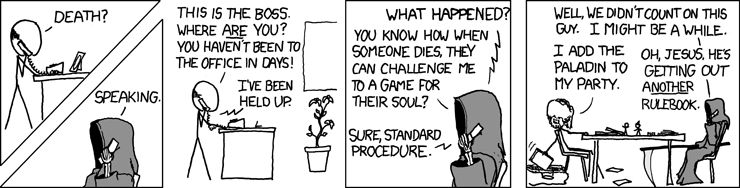

16 Gary Gygax Jokes we better not catch you making
- “Quick! Someone cast Raise Dead!â€
- “Don’t worry – he’s just playtesting the Astral Plane for the next edition.â€
- “He’s gone the way of Star Frontiers.â€
- “Analysts warn of a free-fall in Mountain Dew futures.â€
- “In the next town, you meet a stranger named Barry Bygax.â€
- “Now who will lead our young people to Satan?â€
- “With his last breath, he cursed the name of Marlon Wayans.â€
- “I wonder how they’ll divide up his XP.â€
- “Pallbearers, make a Bend Bars/Lift Gates roll.â€
- "At least he didn't live to see Disney's Greyhawk On Ice."
- “Lorraine Williams is behind this somehow, I just know it.â€
- “The worlds of adventure gaming, fantasy fandom, and van painting will never be the same.â€
- “When I heard, I cried 2d10 tears.â€
- “Is there anything in the will about electrum?â€
- “Heart condition? Wow, I always thought it’d be owlbears that got him.â€
- “Suddenly, nobody in Heaven wants to hang out with Marilyn Monroe on Friday night.â€
[youtube]http://www.youtube.com/watch?v=fVsTtSrOMsI&eurl=http://notfrisco2.com/leones/?p=3278[/youtube]

[youtube]http://www.youtube.com/watch?v=h1UDwvHC93o&eurl=http://www.technorati.com/videos/youtube.com%2Fwatch%3Fv%3Dh1UDwvHC93o[/youtube]
Thursday, March 6, 2008
Why I love teh intertubes (part 31,076)
This is good:
[youtube]http://www.youtube.com/watch?v=z25t-PQDn5A[/youtube]
And this is good, and makes the other one better:
[youtube]http://www.youtube.com/watch?v=2yoIEWpl9oc&watch_response[/youtube]
[youtube]http://www.youtube.com/watch?v=z25t-PQDn5A[/youtube]
And this is good, and makes the other one better:
[youtube]http://www.youtube.com/watch?v=2yoIEWpl9oc&watch_response[/youtube]
Absolutely, totally random thought-of-the-day
Had a biz meeting in a local restaurant. Noticed that there was a painted-on window treatment above the big picture windows. You know... fake, painted valences. It occurred to me that "valence" and "painted" are words that do not get together often. This restaurant had another couple fun painted, atmospheric effects, including a painted-on fireplace and bookshelf.
Which prompted the thought, "I hope the urinals are not trompe-l'oeil."
Words that don't get together much: "urinal" and "trompe-l'oeil."
Probably a good thing.
We now return you to your regularly scheduled Internets.
Which prompted the thought, "I hope the urinals are not trompe-l'oeil."
Words that don't get together much: "urinal" and "trompe-l'oeil."
Probably a good thing.
We now return you to your regularly scheduled Internets.
Saturday, March 1, 2008
Postmodern cartoons

If you haven't seen Garfield Minus Garfield, check it out. Pretty amusing.
The number of things you have to know about culture, psychology, etc. in order to find this funny is creepy in and of itself. The deconstruction of a comic strip, minus its star, points to a public that is increasingly sophisticated when it comes to choosing how to read material at any given moment.
Question for the gang... is this funnier if you hate or love Garfield in its original state?
Google Sites: A front door into the Universal Library
After more than a year, JotSpot (bought by Google that long ago) has come out from behind the gCurtain and has reemerged as Google Sites.
I blogged the Google purchase of JotSpot back in November of 2006; I called it the "2nd wiki that Google bought." Writely (the engine for Google Docs) being the first.
So... now you can use Google to create not just pages that you can view (iGoogle), but pages that you can share with everyone. Visitors can view the pages, registered users can create/edit stuff. [I'll have a better review of the functionality after I get a Google Site up and running]
So what? So you can now use Google to search, create docs, create Web pages, share stuff, etc. etc. Nothing new here, right? These aren't the droids you're looking for...
Maybe they are.
I keep pointing people to this essay by George Dyson on Edge. In it, he says:
Emphasis mine.
The biggest library in the universe is the one of those works as yet to be written. Every year the Web sees the creation of more content than exists in the Library of Congress. I don't want to discuss the relative value of those materials at this point. I'm just noticing that lots of people are adding lots of new stuff to "The Library" all the time.
And now Google has pushed out another service by which that content can be... manipulated? Captured? Serviced? Advertised? Searched? OK... whatever you want to call it. You can do it on Google.
So what? Some will ask. I can create a Web site on MySpace or WordPress or with a free, generic tool and a couple bucks on GoDaddy. It's not that what Google is doing with Google Sites is particularly unique, it's that it's doing it in conjunction with everything else.
Creation, too, has a much bigger brand footprint than search, advertising, etc. When you create something, you put yourself into it. The Web becomes more "yours" when you create a Wikipedia entry or post a YouTube video. Or if you create a site with Google.
No prognostication on this post. Just observation. The world's mightiest search/advertising engine is now even further into the business of creativity as well as findability. It's the printing press for the Universal Future Library as well as the table of contents and advertiser.
I blogged the Google purchase of JotSpot back in November of 2006; I called it the "2nd wiki that Google bought." Writely (the engine for Google Docs) being the first.
So... now you can use Google to create not just pages that you can view (iGoogle), but pages that you can share with everyone. Visitors can view the pages, registered users can create/edit stuff. [I'll have a better review of the functionality after I get a Google Site up and running]
So what? So you can now use Google to search, create docs, create Web pages, share stuff, etc. etc. Nothing new here, right? These aren't the droids you're looking for...
Maybe they are.
I keep pointing people to this essay by George Dyson on Edge. In it, he says:
The books that have been written are easy. They represent the collective memory and imagination of mankind, and the technical resources now exist to deliver The Complete Works of Homo Sapiens, Unabridged. Who can argue against this? It is the realization of every librarian's dream — unless you harbor suspicions about who is going to need librarians once the Universal Library has digested all the books... The Universal Library promises us a repository for the souls of all existing books — and the resurrection of all titles that have gone extinct. And the books that have not been written yet?
Emphasis mine.
The biggest library in the universe is the one of those works as yet to be written. Every year the Web sees the creation of more content than exists in the Library of Congress. I don't want to discuss the relative value of those materials at this point. I'm just noticing that lots of people are adding lots of new stuff to "The Library" all the time.
And now Google has pushed out another service by which that content can be... manipulated? Captured? Serviced? Advertised? Searched? OK... whatever you want to call it. You can do it on Google.
So what? Some will ask. I can create a Web site on MySpace or WordPress or with a free, generic tool and a couple bucks on GoDaddy. It's not that what Google is doing with Google Sites is particularly unique, it's that it's doing it in conjunction with everything else.
Creation, too, has a much bigger brand footprint than search, advertising, etc. When you create something, you put yourself into it. The Web becomes more "yours" when you create a Wikipedia entry or post a YouTube video. Or if you create a site with Google.
No prognostication on this post. Just observation. The world's mightiest search/advertising engine is now even further into the business of creativity as well as findability. It's the printing press for the Universal Future Library as well as the table of contents and advertiser.
Sunday, February 24, 2008
Time over gold
It takes love over gold nd mind over matter
to do what you do that you must
when the things that you hold can fall and be shattered
or run through your fingers like dust.
Dire Straits, "Love Over Gold"
Kevin Kelly wrote a great post recently titled, "Better than Free." In it, he makes the point that, "...when copies are free, you need to sell things which cannot be copied." He asks the question, "...why would we ever pay for anything that we could get for free? When anyone buys a version of something they could get for free, what are they purchasing?" He then goes on to list eight "generatives" (because they generate value) that are "better than free." They are (and I'm going to shorten his description of each, and add my own little parenthetical tag that will make sense in a minute):
What I noticed about Kelly's list when I first read it is that all but two of these "generatives" map to some kind of time value as opposed to product value. And I believe that the two "red herrings" I noted above, while indeed "better than free," aren't related to the digital world, which is what Kelly's main (and excellent) point is about. I think he should lose those two from the list. Why?
"Embodiment," is actually the idea of something having a tangible, "non-free" value, without regard to the content, per se. I can create the wonderful, creamy, cottony book experience for an absolute crap novel, and the physical value of the leather, paper, gold trim, etc. will be the same as if I print a book I love the same way. Any value I place in the book I love vs. the crap novel is the same value that differentiates a free, digital copy of the two works.
Second, "patronage" is a value that works as well (or maybe even better) in the physical world as it does in the digital. The idea that a digital copy I pay an artist for, in order to support their work, has more value to me than one I steal is, indeed, true. But you cannot separate out the value of patronage from the overall value of the work, digital or otherwise. Users will get no "patronage value" from a piece of work that they detest. And they may, in fact, have a negative patronage experience if they support an artist, and then are burned by a bad product. In short, what I think I'm trying to say is, patronage only works as a value if someone was going to value something anyways.
So... of the eight, six are, I think, pretty directly related to the value of time. I've been talking about this with my advertising students for a couple of years now. In order to understand the history of advertising, you have to start with a point in time when there was almost *no* advertising. And why was there no advertising? Because people made almost everything they needed, and had very access to cash. In that environment (which accounts for most of the last 10,000 years of civilized-ish human economic history), real value almost always devolves to land, in one form or another. You live on the land, get your food from it, get wood and coal and metals from it, get water there, etc. etc. You can't have a king without a kingdom, and the "dom" is the land.
Over the last 150 years or so, though, we've moved away from land-as-root-value. Yes, it's still there, of course. As the man said, real estate is a good investment because they ain't making any more of the stuff. But more and more frequently, those things with the most value have little connection to real property.
One definition of wealth I heard years ago and really liked was, "Wealth is a measure of excess food." Right. If you have to spend 100% of your time hunting/gathering in order to barely survive, you are as poor as you can be and not be dead. Better control/ownership of the land and its uses provides better/more food for people, allowing them to do things like invent even better farming tools/techniques, be artists, lawyers, teachers, etc. The wealthier a society is, the less time/effort per capita is spent on food, giving people more time to do other stuff that can add to the quality of life.
Did you notice how we moved into "time" as a value even in that discussion? Society (everybody doing something) needs to produce food, or we die. Less time spent on food = more time for fun, games, medicine, music, etc. As soon as somebody figured out how a horse can plow the same plot of land and get more food off'n it, the equation changed from "land is the basis of all wealth," to "technology that improves the land use is a good thing, too."
Back to Kevin's list. And to a discussion on Terra Nova about whether or not the theft of virtual items counts as theft. When we pin all our ideas about possessions, wealth, etc. on "stuff" (like land), then the idea of virtual theft is absurd. Of course the owner/publisher of the game can just "undo" the theft instance and give us back our virtual thing-a-ma-bob. That's not the point. I'm not paying the publisher (or the advertiser) in order to have access to things; I'm "spending my time." And that's a phrase that, now, I think is hugely significant.
We live in an age when food is almost free. Or course, this is only true in those societies engaged in the kind of digital economics that Kevin talks about. Very few areas where starvation is a real issue are in any way worried about digital piracy and the value of free copies of content. But for those of us in the "Internet World," food is very, very cheap; about 10-15% of household income for those of us in the middle class. And since most of us don't rely on investment income from real estate (or other tangibles), but on wages... time, in a very real sense, ends up being equal to money for us.
But... that value may not be fungible, depending on how you measure it. If you peg your time back to your salary/wage, you end up with a dollar-per-hour calculation that can easily be compared to that of everyone else. Right? Fred makes $20/hour and Grace makes $40/hour, so her time is worth twice as much as his.
Or is it? Grace's time is worth twice as much to the economy that determines wages based on the service provided. But is it worth twice as much to society in general? Or to their families? Suppose, after work, Fred spends 20 hours a week tutoring kids who need extra help with reading. He does this for free. Grace, on the other hand, watches TV. Nothing wrong with that. But aside from their hours spent working, can we say that an hour of Grace's time watching the Food Channel is as valuable to society as an hour of Fred's time improving the minds of our youth?
And, regardless of the value to society, can anybody but Fred or Grace determine the value of any given activity relative to their own time spent? And another and... can anyone place a value on time spent doing things that are universally acknowledged as having personal value, such as playing with one's kids, going to church, loving up your honey, etc.? Meaning, is one hour of Grace's time spent with her family any more or less valuable to her than an hour of Fred's time spent with his?
We need a new way to think about value when much of what we are concerned with is how we spend our time, rather than how we spend our money. Kevin points out, wisely, that there are things we can do to add value to digital stuff that is easily copied. My view is that most of those "generative" qualities map to relative time-value of various activities. I value...
In regards to virtual theft, then... someone who steals my virtual "stuff," is actually robbing me of immediacy (if I can't use it when I thought I could), authenticity (the "magic circle" of me thinking of my stuff as mine), accessibility (I can't use it when I want), and "findability" (I may have to go back to the publisher for a new copy).
When I spend time on a digital asset, I've assigned value to it relative to anything else I might have done with that time. When somebody/something requires that I spend more time on something, they've robbed me. Thus, DRM that requires me to spend time fiddling around with various protection schemes is robbing me of my time-currency in order to help protect the digital security of some content. The fact that a song I buy on iTunes can't be used on all my devices is a theft of immediacy, findability and accessibility.
Time is the new gold. We should work on ways of assigning and evaluating time-value that aren't rooted in dirt, food and metals.
to do what you do that you must
when the things that you hold can fall and be shattered
or run through your fingers like dust.
Dire Straits, "Love Over Gold"
Kevin Kelly wrote a great post recently titled, "Better than Free." In it, he makes the point that, "...when copies are free, you need to sell things which cannot be copied." He asks the question, "...why would we ever pay for anything that we could get for free? When anyone buys a version of something they could get for free, what are they purchasing?" He then goes on to list eight "generatives" (because they generate value) that are "better than free." They are (and I'm going to shorten his description of each, and add my own little parenthetical tag that will make sense in a minute):
- Immediacy -- Sooner or later you can find a free copy of whatever you want, but getting a copy delivered to your inbox the moment it is released -- or even better, produced -- by its creators is a generative asset. [Get something for less of your time]
- Personalization -- A generic version of a concert recording may be free, but if you want a copy that has been tweaked to sound perfect in your particular living room -- as if it were preformed in your room -- you may be willing to pay a lot... As many have noted, personalization requires an ongoing conversation between the creator and consumer, artist and fan, producer and user. It is deeply generative because it is iterative and time consuming. You can't copy the personalization that a relationship represents. [Get something better that someone else has spent time on]
- Interpretation -- As the old joke goes: software, free. The manual, $10,000. But it's no joke. A couple of high profile companies, like Red Hat, Apache, and others make their living doing exactly that. They provide paid support for free software. [Experts save you time]
- Authenticity -- You might be able to grab a key software application for free, but even if you don't need a manual, you might like to be sure it is bug free, reliable, and warranted. You'll pay for authenticity. There are nearly an infinite number of variations of the Grateful Dead jams around; buying an authentic version from the band itself will ensure you get the one you wanted. Or that it was indeed actually performed by the Dead. [Don't waste time on fake crap]
- Accessibility -- Ownership often sucks. You have to keep your things tidy, up-to-date, and in the case of digital material, backed up. And in this mobile world, you have to carry it along with you. Many people, me included, will be happy to have others tend our "possessions" by subscribing to them. [Timeliness]
- Embodiment -- At its core the digital copy is without a body. You can take a free copy of a work and throw it on a screen. But perhaps you'd like to see it in hi-res on a huge screen? Maybe in 3D? PDFs are fine, but sometimes it is delicious to have the same words printed on bright white cottony paper, bound in leather. Feels so good... The music is free; the bodily performance expensive. This formula is quickly becoming a common one for not only musicians, but even authors. The book is free; the bodily talk is expensive. [This is a red herring as far as this discussion goes... more on that in a moment]
- Patronage -- It is my belief that audiences WANT to pay creators. Fans like to reward artists, musicians, authors and the like with the tokens of their appreciation, because it allows them to connect... The elusive, intangible connection that flows between appreciative fans and the artist is worth something.... There are many other examples of the audience paying simply because it feels good. [patronage is based on the emotional/brand connection between buyer and seller; another red herring on this list, I think]
- Findability -- Where as the previous generative qualities reside within creative digital works, findability is an asset that occurs at a higher level in the aggregate of many works. A zero price does not help direct attention to a work, and in fact may sometimes hinder it. But no matter what its price, a work has no value unless it is seen; unfound masterpieces are worthless. [Findability = value in less time]
What I noticed about Kelly's list when I first read it is that all but two of these "generatives" map to some kind of time value as opposed to product value. And I believe that the two "red herrings" I noted above, while indeed "better than free," aren't related to the digital world, which is what Kelly's main (and excellent) point is about. I think he should lose those two from the list. Why?
"Embodiment," is actually the idea of something having a tangible, "non-free" value, without regard to the content, per se. I can create the wonderful, creamy, cottony book experience for an absolute crap novel, and the physical value of the leather, paper, gold trim, etc. will be the same as if I print a book I love the same way. Any value I place in the book I love vs. the crap novel is the same value that differentiates a free, digital copy of the two works.
Second, "patronage" is a value that works as well (or maybe even better) in the physical world as it does in the digital. The idea that a digital copy I pay an artist for, in order to support their work, has more value to me than one I steal is, indeed, true. But you cannot separate out the value of patronage from the overall value of the work, digital or otherwise. Users will get no "patronage value" from a piece of work that they detest. And they may, in fact, have a negative patronage experience if they support an artist, and then are burned by a bad product. In short, what I think I'm trying to say is, patronage only works as a value if someone was going to value something anyways.
So... of the eight, six are, I think, pretty directly related to the value of time. I've been talking about this with my advertising students for a couple of years now. In order to understand the history of advertising, you have to start with a point in time when there was almost *no* advertising. And why was there no advertising? Because people made almost everything they needed, and had very access to cash. In that environment (which accounts for most of the last 10,000 years of civilized-ish human economic history), real value almost always devolves to land, in one form or another. You live on the land, get your food from it, get wood and coal and metals from it, get water there, etc. etc. You can't have a king without a kingdom, and the "dom" is the land.
Over the last 150 years or so, though, we've moved away from land-as-root-value. Yes, it's still there, of course. As the man said, real estate is a good investment because they ain't making any more of the stuff. But more and more frequently, those things with the most value have little connection to real property.
One definition of wealth I heard years ago and really liked was, "Wealth is a measure of excess food." Right. If you have to spend 100% of your time hunting/gathering in order to barely survive, you are as poor as you can be and not be dead. Better control/ownership of the land and its uses provides better/more food for people, allowing them to do things like invent even better farming tools/techniques, be artists, lawyers, teachers, etc. The wealthier a society is, the less time/effort per capita is spent on food, giving people more time to do other stuff that can add to the quality of life.
Did you notice how we moved into "time" as a value even in that discussion? Society (everybody doing something) needs to produce food, or we die. Less time spent on food = more time for fun, games, medicine, music, etc. As soon as somebody figured out how a horse can plow the same plot of land and get more food off'n it, the equation changed from "land is the basis of all wealth," to "technology that improves the land use is a good thing, too."
Back to Kevin's list. And to a discussion on Terra Nova about whether or not the theft of virtual items counts as theft. When we pin all our ideas about possessions, wealth, etc. on "stuff" (like land), then the idea of virtual theft is absurd. Of course the owner/publisher of the game can just "undo" the theft instance and give us back our virtual thing-a-ma-bob. That's not the point. I'm not paying the publisher (or the advertiser) in order to have access to things; I'm "spending my time." And that's a phrase that, now, I think is hugely significant.
We live in an age when food is almost free. Or course, this is only true in those societies engaged in the kind of digital economics that Kevin talks about. Very few areas where starvation is a real issue are in any way worried about digital piracy and the value of free copies of content. But for those of us in the "Internet World," food is very, very cheap; about 10-15% of household income for those of us in the middle class. And since most of us don't rely on investment income from real estate (or other tangibles), but on wages... time, in a very real sense, ends up being equal to money for us.
But... that value may not be fungible, depending on how you measure it. If you peg your time back to your salary/wage, you end up with a dollar-per-hour calculation that can easily be compared to that of everyone else. Right? Fred makes $20/hour and Grace makes $40/hour, so her time is worth twice as much as his.
Or is it? Grace's time is worth twice as much to the economy that determines wages based on the service provided. But is it worth twice as much to society in general? Or to their families? Suppose, after work, Fred spends 20 hours a week tutoring kids who need extra help with reading. He does this for free. Grace, on the other hand, watches TV. Nothing wrong with that. But aside from their hours spent working, can we say that an hour of Grace's time watching the Food Channel is as valuable to society as an hour of Fred's time improving the minds of our youth?
And, regardless of the value to society, can anybody but Fred or Grace determine the value of any given activity relative to their own time spent? And another and... can anyone place a value on time spent doing things that are universally acknowledged as having personal value, such as playing with one's kids, going to church, loving up your honey, etc.? Meaning, is one hour of Grace's time spent with her family any more or less valuable to her than an hour of Fred's time spent with his?
We need a new way to think about value when much of what we are concerned with is how we spend our time, rather than how we spend our money. Kevin points out, wisely, that there are things we can do to add value to digital stuff that is easily copied. My view is that most of those "generative" qualities map to relative time-value of various activities. I value...
- Immediacy -- Getting something in less time
- Personalization -- Getting something someone else has spent time matching to my needs, rather than having to spend that time myself
- Interpretation -- The time of experts
- Authenticity -- Not wasting my time on stuff that will suck
- Accessibility -- Being able to get something at any time
- Findability -- Spending less time looking for something
In regards to virtual theft, then... someone who steals my virtual "stuff," is actually robbing me of immediacy (if I can't use it when I thought I could), authenticity (the "magic circle" of me thinking of my stuff as mine), accessibility (I can't use it when I want), and "findability" (I may have to go back to the publisher for a new copy).
When I spend time on a digital asset, I've assigned value to it relative to anything else I might have done with that time. When somebody/something requires that I spend more time on something, they've robbed me. Thus, DRM that requires me to spend time fiddling around with various protection schemes is robbing me of my time-currency in order to help protect the digital security of some content. The fact that a song I buy on iTunes can't be used on all my devices is a theft of immediacy, findability and accessibility.
Time is the new gold. We should work on ways of assigning and evaluating time-value that aren't rooted in dirt, food and metals.
Subscribe to:
Posts (Atom)