Last year I wrote a post called The UnGrinch 25; a list of ideas on how to keep the fun, spirit and joy in your holiday season. In order to challenge myself, I'm upping the ante this year. So let's see if I can come up with 50 ways to beat the Holiday Humbugs. I will be incorporating last year's list, but adding new stuff (duh) and grouping things in five categories, 10 ideas each for (jump links ahead): crafts, entertaining, cards, gifts/shopping and meaningfulness. So... away we go.
10 Craft Ideas
1. Make a family calendar. Pick a theme or use pics of your family. Fill it with all the important family dates; birthdays, anniversaries, etc. Include a weird or interesting events from Chase's Annual Events. You can make monthly calendars using MS Publisher, or the ever-free and wonderful Open Office. Good to have, good to give.
2. Create your own ornaments. My favorite, as a kid, was to take a styrofoam shape (bell, star, even a simple ball), and stick a bajillion sequins to it with pins. Pretty. Shiny. And it keeps kids busy for hours while you do other holiday nonsense. Another ornament idea (bonus!) is to take beads (I like the shiny, little, star-flowery shaped ones) and string them along a piece of craft wire. When you're done, you end up with an ornament that's also a bendy toy.
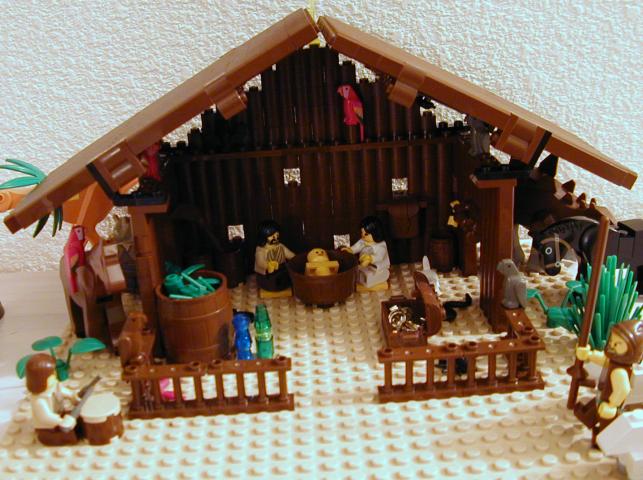
3. Lego nativity scene. 'Nuff said.
4. Toys from tots. There are many organizations that gather up toys for kids who don't have them. And that's fantastic. But kids also love to make and give stuff around the holiday season, and may not have the resources. Organize an effort to provide a crafty sort of event where all the necessary parts and instructions for making a neat holiday gift are available to a group of kids who otherwise wouldn't have access. My bet is that if you or your organization provided the stuff and the supervision, your local, public library could help you find a place to do it.
5. Make a truly edible gingerbread house. Every gob-smacked gingerbread house I've ever seen has been "hands off" (and more importantly, "teeth off"). Feh! Where's the fun? I mean... C'mon! I don't care if you stick six graham crackers together with peanut butter and put one gum-drop on top for a chimney. Do it, and then let the kids get all Godzilla on it. Or chomp it down yerself. You know you want to...
6. Decorate somebody else's space. Carefully. Tastefully. Always within the bounds of office rules/etiquette and the law/fire-code. But how nice would it be to enter your office (cube...) and find a wee, unexpected holiday trinket? Totally anonymous. Or to come home and have a strange, lovely wreath hanging on your lamp-post? Put a small, stuffed penguin with a Santa hat on someone's dashboard today.
7. Group shoebox calendar. Warning: takes planning. Everybody in your gang (family, office, church-group, etc.) brings in enough shoeboxes to make 25. Everybody puts something in them to help decorate the common space. Wrap them (and keep the innards secret), then randomly assign numbers 1-25 to them. Or more or less if you're doing a non-religious thing. Do 31 and make it a "New Year's Calendar." Whatever. Then, on each day, get together as a group, open the appropriate box (take turns, now) and use it to brighten the day and make the place niftier.
8. Bad Mojo Wreath Voodo. OK... this one will probably not go down well for many church youth groups... but it's meant with a sense of humor, so chill out. Have everyone in your gang (family, group) write something that bugs them on a piece of colored paper that matches (or not) the cheapest, driest, most flamable wreath you can find. Decorate the wreath with the slips of nastiness. On the day of celebration, burn (or otherwise destroy in a more work-friendly manner) the Wreath of Spite. Celebrate the destruction and release of the things that bug you.
9. Holiday bird-feeder. I like bird-feeders. So do my squirrels. Oh, well... But mostly they either look like weird plastic contraptions or little A-frame tenements. Help a bird out. Decorate a special bird-house/feeder for the holidays.
10. Odd snow sculpture. We all make the snowmen. Yes, yes. Lovely snowmen. Do it up different this year. Make a snow carving of your company's logo. Never mind. Don't do that. How about a UF-SNOW? Unidentified Freezing Snowcraft? Or a guy climbing up your front tree? Or a giant hand? Don't be overly critical of your work... just get some friends together and get stupid with the snow.
10 Entertaining Ideas.
1. Rewrite "The Twelve Days of Christmas." Let's face it, hollering, "Fiiiiive gooolden riiings!" is way fun. Way, way fun. You can not resist, so don't hold back. But what's even more fun, is hollering your own family version that only you and the clan know. Because, really... doesn't singing about how your true love gave to you... "eight maids a milking" make you a bit... uncomfortable? I mean... dude gives people for Christmas? That ain't right. Bob and Doug McKenzie not withstanding, your own version will be more fun. My son, just this morning, was singing, "Fiiiiive gooolden delicious!" Hilarious.
2. Indoor snow-ball fights. We spent two years of my childhood in California, after having lived in Boston, and with parents who grew up in New York. Snow ball fights are a required element of winter joy. Indoor? Substitute aluminum foil balls, rolled-up socks, styrofoam (messy), newspaper wads, etc. instead of snow. The point is to throw things. Banzai!
3. Mall caroling. It's hard to find places to carol. Outside can get very cold. And, with kids in tow... well, it's tough. Check with a couple local malls and arrange for a time to invite anyone who'd like to participate to meet, get song books, and walk around the mall singing. See if you can arrange for an accordion player. Seriously. It adds to the cheer. If you want to charge a couple bucks to participate and also collect donations from listeners and then give the money to a local toys-for-tots charity, that makes the whole deal more righteous, and more palatable to certain civic types.
4. Grown-up PJ party. Notice I did not say "adult." This is not a chance to play spin-the-bottle. This is about getting back to childishness. Come in PJs, bathrobes, bunny-slippers, blankets, etc. Bring your favorite (hopefully holiday related) bed-time story to read aloud to the group. Drink cocoa w/ tiny marshmallows (yes, and some brandy or JD) and have candy canes and graham crackers for snacks. Sit on the floor around the fireplace. Watch all the old
Rankin-Bass claymation holiday specials on VHS. Sing a few carols. Play...
5. Insane White Elephant. Last year, John Moore from Brand Autopsy set up an excellent White Elephant Blog. It ain't up this year. Oh, well. The basic principles of a White Elephant gift exchange apply, but anyone who has their gift taken can keep stealing from anyone who hasn't yet had their gift stolen that turn. The more people playing, the more fun. No "deceased" gifts in this version, either. Until you've had a gift stolen on any given turn, it's in play.
6. Make-a-wreath party. OK... this is a combo craft/entertainment idea. So sue me. We used to do this at the church I grew up going to. You show up with the basics of an advent wreath (styrofoam torus and a bunch of evergreen branches), and the host provides all kinds of add-ons; candles and holders, bells, ribbon, holly, berries, etc. Good times, and a wreath to take home, too.
7. Semi-formal holiday martini party. In the old days (the 1950's), people dressed up to go to holiday parties. And while this may still hold true for some work-sponsored events, more and more often, work holiday parties are tired, dull affairs. Most of the ones I've been to are, anyways. So, on your own, get some friends together and dress all high-class, and drink funky, fun martinis. No reason grown-ups can't have grown-up fun around the holidays, too.
8. Remembrance time. Around the table, have family members or friends recount their best (or most interesting) holiday memories. Yes, it's corny. But corny is good during this time of the year. Embrace the corn.
9. Tell your faith's holiday story with sock puppets. You never real own a story until you tell it. I know this, because I played King Nebuchannezzar in a 4th grade production of, "Cool in the Furnace." I now own The Firey Furnace. Be that as it may... You can hear the Christmas, Hanukkah, Kwanzaa, Yule, Solstice, etc. stories again and again. But until you write out a script, make your own sock puppets for the players, fashion a stage from a major appliance crate and put on a show for the grown-ups... do you really grok the holiday's true meaning? I think not.
10. Mix-up the classics. Get the book versions of classic holiday tales like Rudolph, Santa, Frosty, Night Before Christmas, A Christmas Carol, etc. Get some index cards. Write character names, major attributes ("nose glows," "miser," "made of snow," "elf,") and plot points ("comes down the chimney," "ridiculed by reindeer," "just settled down for a long winter's nape") on them and keep the categories separate. Now go back and read one of the originals, but when someone (usually a child or me) yells "stop!," insert a random card from the appropriate face-down pile. So you end up with something like:
"Rudolph didn't like all the other reindeer calling him names, so he..."
"Stop!"
"... gave Bob Cratchit money to help with Tiny Tim's legs."
You can keep going with the original story, substituting other zaniness, or switch over to the one from the card. Whichever seems like more fun to you. And, yes, this is kind of a holiday version of TaleWeaver.
10 Card Ideas
1. Make your own envelopes. A dear friend of mine (Hi, Susan!) once sent me letters every few months in hand-made envelopes. Hers were made from interesting magazine ads. How cool is that? If you want to get fancy, do a search on the Internet for "make envelopes" and such. But the easiest way is to get the envelopes that go with whatever cards you're mailing, carefully bust 'em apart, trace them on funky paper (magazine pictures, wallpaper, wrapping paper...) and then cut, fold and glue (or double-sticky clear tape) them together. People may expect hand-made cards. Nobody expects the Spanish Inquisition. Or hand-made envelopes. Festivisimus! 2. Photoshop your kid(s) into other (classic) pics. I first saw this done to Raphael's "The Sistine Madonna, Detail of the Angles" painting (as shown). Although a much better job than the one I've done here, which is of my niece and nephew (Hi, Nate! Hi, Sophie!) Click on it to see a much larger image. The point is to have fun and take a picture folks will recognize and include people they will recognize. It doesn't have to be a serious pic, either. I would think that your kid climbing the Empire State Building to put a star on top would be hysterical. Use this instead of a regular picture-of-your-kids card because... well... because it's goofy. Combine with #9, below, for best effect.
3. Gift cards for chores, favors, hugs, etc. These were a big item when I was growing up. Don't know if other people did them. The idea was to make gift-certificates or gift cards that "entitled the bearer to (1) one doing of the dishes upon presentation of this card." You can make these intimate for your honey (I won't get into those variations here, thank you), or appropriate for work. For example, I once gave my boss ten "Andy will now pipe down" certificates. Upon presentation, I was obligated to shut my pie hole. She only ever handed me two. I believe she traded the rest in for some magic beans. Or they may be floating around on eBay... Hmmm....
4. "Puzzle Party" cards. Take, buy or make a nice picture and turn it into a jigsaw, either yourself or at Kinkos. Mail one piece to each person you're inviting to the party. When they come, they add their piece. Depending on how corn-ball you are, you can hold forth on how we're all a part of the holiday panorama of joy, etc. etc. It also serves to increase the guilt factor that motivates people to come to your party, since if they don't... their piece will be missing. Ha!
5. "Family News" cards from the future. I love this one. Lots of families I know write a very nice update about what's been going on over the last year. It's nice to hear, but... mostly it ends up being, "Dad's still working and maybe going a bit more stir crazy. Same for mom. The kids are in school and are a year older." Yawn... I like the idea of fast-forwarding a bit and writing your "Holiday Family News from 2025." Keep it just as straight-faced and boring, but mention which dimension Mary got lost in on the way to work this time. Talk about how the Martian embassy lost your passport on your 2nd honeymoon cruise, etc. etc. Much more fun. Cloning humor goes over big in this one, too.
6. Mystery cards. Send a really nice holiday card, maybe include a gift certificate, but with no indication of whom it's from; no names, no return address, etc. Why? To bug the crap out of somebody you love. And isn't that what the holiday season is all about?
7. Return-reply cards. Send people a card with a self-addressed, stamped envelope or postcard inside to send back to you. Put questions on it you'd like answered, like... what do you want for Christmas next year? How the heck are ya? Which holiday movies did you see and like or hate? People love to be interactive. Give the gift that gives something back to you.
8. Custom mouse pad card. They will throw away the picture of your kids. But if you put that picture on a custom mouse pad... it's a keepsake.
9. Nice, custom cards. While we're visiting Cafepress.com. ... You can go to the drug store and have any photo turned into a card. And they sure look like you did just that. But if you take a few more minutes, you can actually have custom cards printed out for you. Ones that look like cards. Which is nicer, you must admit. Combine this with #2, above.
10. Origami cards. Do your regular card, but include a piece (or more, if necessary) of origami paper and instructions for making an ornament, decoration, etc. Your local library has holiday origami books, I bet. Again... the point is to do something different... with a little extra un-Grincy flavor.
10 Gift/Shopping Ideas
1. Surrogate shopping party. So many of us have someone or several someones on our lists that are impossible to shop for or that we just have a mental block on. Fine. Get together for dinner and share an equal number of those folks with each other, along with a few details and a dollar ceiling per gift. Then release yourselves into a mall with a time limit. Then get back together and share the swag. I guar-ohn-tee that your friends will find stuff for your hard-to-getters that you'd never have thought of. If it ain't right? Well, 'tis the season to return stuff.
2. Thought gifts. They say, "It's the thought that counts." OK. So, this year, only give thoughts for the holidays. Make this the year that you and yours agree to take whatever your budget for gifts was and either give it to a charity or stick it in a savings vehicle; your call, I'm not preaching here. But for yourselves... take the time to actually say the things you haven't said. Give "the thought" behind the gift. If you're a spiritual person, pray or meditate on the subject for a bit. Do it in a card if you like, or via email. Don't make the logistics as much of a pain as shopping/wrapping/etc. That's not the point. But all the major religions that are celebrating this time of year have gift-giving as a central notion not as a potlatch per se, but as a metaphor for love, friendship, community, etc.
3 Archie McPhee. This idea is a straight-up pimp for the Jumbo Mystery Box from Archie McPhee. I get one of these every year (although this year I have been strongly advised that the ladies want something non-McPhee in their stockings... geez), and use the contents for stockings, Secret Santa, random giftings, prizes for students, etc. You never know, around holiday time, when a bunch of Hindu god finger puppets, glowing eyeballs or rampaging Hun toy soldiers will come in handy.
4. Gifts for the future of the group. Have everybody get everybody something that will only really "work" when you get back together. Pick a group-y activity like a picnic or game night, and have everyone get/give gifts that will be brought together again each time you do that thing.
5. Recommendations or reviews. I get lots of gift certificates. And that's cool. But it still means I need to figure out what I want to get with the thing. If you give someone a gift certificate (especially to a book or music store/site), provide a list of 5 or 10 ideas that you think they'd like. Write little mini-reviews of books you've read, movies you've seen, etc. that made you think of the person. Make the list fun, funny or serious... but it will add personality and thought to what can seem like a somewhat generic offering.
6. Make part of the gift yourself. Homemade gifts are special, when they come from adults as well as kids. I recently received a CD from a friend, and it was wrapped in a handkerchief that he'd tie-dyed himself. How cool is that?! If you give someone a coffee machine, create a custom mug for them, too.
7. Food with gifts inside. I don't know why this is fun, but it is. Make sure you warn people, and make the gifts obvious (small gems can be a choking or tooth-breaking hazard). Seal stuff in zip-lock bags to preserve the food and the toys. Put something in the Jello (action figures?) that will make digging out the prize as much fun as playing with it.
8. Gifts with a story. Write a fictional story about how the gift you're giving came into your hands. Make it funny, sweet, odd, implausible... whatever. It will make the present more memorable.
9. Don't overthink. We spend so much time (well, I don't, but "we" do) trying to figure out the "perfect gift" for people. Unless you're sweetie is waiting for a ring, or your 8-year-old will DIE without a particular Lego set... there ain't no such thing. Part of the fun of gifts is getting something you wouldn't ever have bought for yourself. If it wasn't, we'd just give each other money. Bleh. So give something odd and unexpected. I mentioned Archie McPhee before. Another great site full of fun and different ideas is the Quincy Shop. Very unique stuff, in a wide range of prices and styles. Really fun. This year, somebody better get me a Buddha Board Zen Art thing, or I'm a-gonna cry. I got most of last year's stocking stuffers from their "Unique Gifts Under $10" section. Their selection and service gets the Andy Havens' Seal of Wow! That's Neat!
10. Share kids. Childhood is a big part of the holidays; both our own and our kids'. If you don't have kids and are friends with someone who does, offer to babysit so that they can go out and shop, and then do one of the craft things above. If you do have kids, and know folks that don't, invite them over for an event where the kids will play a part. Holidays go better with runts.
10 Meaningful Ideas
Hopefully, all the above ideas can be meaningful. This last set, though, is meant to supply you with specific, holiday depth and feelings of joy, brotherhood, jolly...tude? Jolliness? That sounds better.
The holidays can be meaningful? Go figger.
1. Start a bizarre, personal holiday tradition. I heard somewhere (can't find it online, sorry... it may be apocryphal) that Amy Grant's family explodes their Christmas tree after New Year's Day with fireworks. I'm neither hot nor cold on Ms. Grant, but... that's flippin' awesome!!! So many of our holiday traditions are either copped from cultures that really aren't our own anymore, or have been entirely kidnapped by the media/mercantile world. Why not invent a new ritual that's just for you and your family? Stuff a sock with toys by the fireplace? Why? I sure as heck don't know. How about, instead, everybody in your family writes one line of a nativity poem. Or fight some gingerbread man wars. Or make advent candles from last year's used crayons. At my house, we've now been playing street hockey the day after Christmas for several years with all the in-laws. Why? Bob wanted to one year. After three years... It's a tradition!
2. Overtip, ridiculously, at least once. Food service is tough work. And around the holidays, it's even worse. People are out-and-about, running like mad, full o' holiday spirit, and, often, not very nice to the wait staff. And because we're spending more than we should on various baubles, bangles and beads... we're often a bit penurious when it comes to the everyday stuff. Which hurts the folks whose livelihood depends on our largess. So. At least once, between Thanksgiving and New Year, when you get good service and a nice smile with your meal... leave a $20 tip on a $13 lunch meal. Or, what the heck... leave $50 to cover a $22 dinner. Or $100 for a cup o' joe. Seriously. Don't make a big deal out of it. Do it, as the scriptures say, "In the dark." But do it. You'll make somebody's whole season.
3. Start a yearly journal. Very few people keep a journal. I'm a professional writer, and I don't. I'm supposed to, but I write at work, and I blog, and I write poetry and fiction and, and, and... So I've never had a daily journal. But what I do have is a notebook that I take out about once a year. Often around the holidays. And, in my case, I write in it the names of people -- everyone I can remember -- that I've met during the last year or so. And, of course, I go back and read the earlier entries and reflect on how lucky I've been to have known so many wonderful people. The names are my "touchstones" to the past. The names are bookmarks in my memory, because people anchor the most important events in my life, I think. Anyway... that's what's in my "annual journal" for the most part. Yours, of course, can be anything you want.
4. Share a resolution. We don't keep our New Year's resolutions, for the most part, because we are not really accountable to ourselves. We cheat and look the other way. So share a resolution with a friend or family member; let them hold you accountable, and vice versa.
5. Share a resolution. No, this is not a repeat. In this case, I mean make a resolution that includes another person. For example, resolve to have a game-night once a week with your family, or to go for a walk 3 days a week with your spouse. Resolve to send an email back-and-forth at least twice a month with a friend you don't see much anymore. Resolve to cook healthy for me, and I'll cook healthy for you twice a week. Resolve to help your boss with his annoying habit of not taking minutes/notes at meetings, and he can help you with your attempts at better process management. So many things that we want to accomplish are impossible alone. Resolve to be better together.
6. Visit someone else's ceremony. When I was in confirmation class as a young Methodist swain, our pastor took us to a Passover Seder service at one of the nearby Jewish temples. It was a great way to learn about the similarities and differences between my faith and that of my Jewish friends, and to drink wine as a 15-year-old. That specific holiday won't work around December... but you get the point. Find out what and how others are celebrating around this time of the year. You'll end up experiencing your own traditions more deeply, I guarantee.
7. Take someone to a performance of Handel's "Messiah" who's never been. There's a church in your area putting it on, I guarantee. If not (some guarantee, eh?), rent a version from the library. It's truly one of the most beautiful, moving pieces of holiday music you can experience. Sharing it is a great gift.
8. Random (nice) blog comments. If you read lots of blogs, take the time to do something that only 1-in-100 readers generally does; leave a comment. We bloggers write for lots of reasons. But nothing makes our day like a comment from a reader we haven't heard from before. If you've enjoyed the work of a blogger in the past, visit their space and let them know. It takes just a few minutes, and really is a lovely treat for us. Please note, I am not fishing for comments on this blog. I'm projecting. ;->
9. Give to a charity you don't normally connect with. Stretch a bit. If you mostly give at church, find a secular charity that does something you agree with. If you tend towards issues of hunger, try education. I'm not saying don't do the stuff you usually do... but find out about a new one. When our giving becomes rote, we lose something of the original reason we were moved to give. Get out of your comfort zone and find a new way to share.
10. Forgiveness. One of the worst barriers to experiencing spiritual, holiday joy is the sense that we are not worthy. Whether directly or indirectly, too much gift giving is often a substitute for the resolution of actual issues. And one of the issues that really can weigh us down this time of the year is a grudge. Whether you're holding one against someone else, or they're mad at you about something... take care of it. If it's so far in the past that the person is dead, moved on, out-of-touch,etc., then talk to a friend, therapist or confessor of some kind. Get rid of it. I don't care what your religion is or if you have none. The burden of unforgiveness is a strain on the holidays for us all. Lose that, and all the other holiday stuff will be much, much brighter.
Well, that's it for this year. Hopefully you found something in here that will help your holiday be more fun, festive and... fruitful? Well, bad alliteration aside, have a joyful season and a Happy New Year.


 , though, seems OK. Some of the buttons and the keyboard still look a bit odd compared to standard UI stuff... but maybe (benefit of the doubt alert) its related to power savings, hardiness of the unit, whatever. It looks a bit geeky, but, then again, it is.